

A king-size bed takes up real estate in any bedroom, so why not make it work harder? King bedroom sets with built-in storage transform what could be dead space into functional organization. Whether you’re cramped in a city apartment or trying to minimize clutter in a sprawling master suite, storage-integrated king beds offer a practical solution that doesn’t require sacrificing comfort or style. This guide walks through the types available, how to choose one that fits your space, and design considerations to make the investment count.
Table of Contents
ToggleKey Takeaways
- King bedroom sets with storage solve space constraints by eliminating the need for separate furniture pieces while keeping your bedroom floor clear and visually calm.
- Platform beds with under-bed drawers are the most practical option, offering 40-60 liters of storage per drawer and costing $400-$1,200, while storage headboards provide arm’s-reach access to essentials at $200-$2,000+.
- Measure your space carefully before purchasing—king beds require 18-24 inches of side clearance for drawer access, and ceiling height matters for tall headboard styles.
- Solid wood king bedroom sets offer durability and aesthetic appeal ($1,000+), while engineered wood provides budget-friendly alternatives ($400-$800) but may require more careful handling.
- Maximize storage efficiency by using dividers, vacuum-seal bags to compress items by 40-50%, and the file-fold method to organize clothing without sacrificing visibility.
- Ensure proper weight distribution across drawers, maintain air circulation in under-bed storage to prevent moisture buildup, and verify mattress weight limits before purchasing your storage bed.
Why King Beds With Built-In Storage Are Game-Changers
Bedroom square footage is premium real estate, and storage always comes at a cost, either as a separate dresser, nightstands, or closet space. A king bed with integrated storage eliminates that trade-off. You’re not adding a new piece of furniture: you’re making the bed itself do double duty.
For renters or anyone without sufficient closet depth, under-bed drawers hold seasonal clothing, linens, or bedding without eating into floor space. Storage headboards let you tuck books, remotes, phones, and nighttime essentials at arm’s reach instead of cluttering a nightstand. In smaller bedrooms, this consolidation is often the difference between a cramped, awkward layout and a room that breathes.
Beyond footprint savings, organized storage reduces visual clutter. A bedroom with a clear floor and everything stowed feels larger, calmer, and easier to keep clean. That psychological benefit is real, especially when you’re downsizing or working with limited square footage.
Types of King Bedroom Sets With Storage
Not all storage beds are built the same. Understanding the main categories helps narrow your options based on bedroom layout, budget, and access habits.
Platform Beds With Drawers
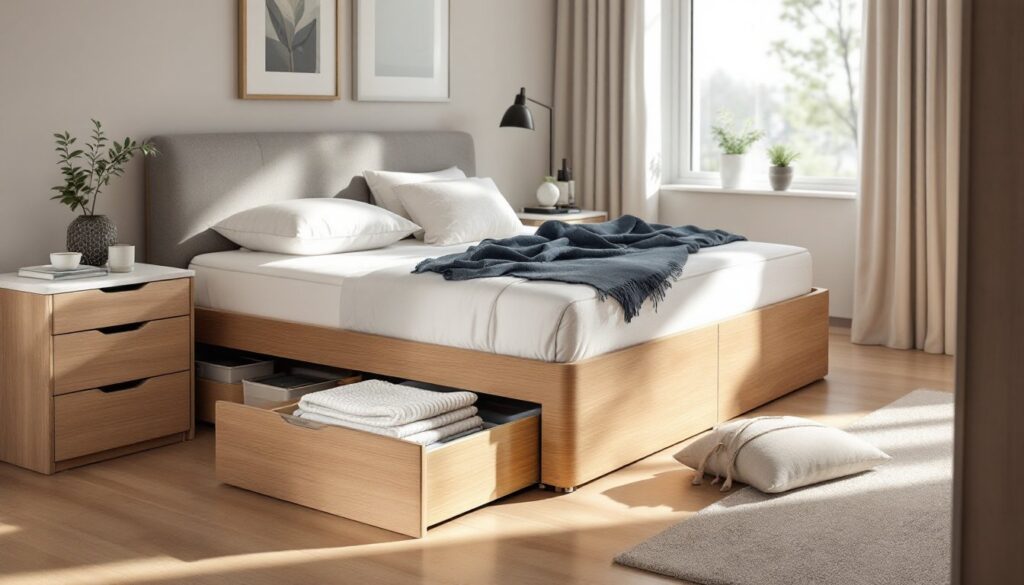
A platform bed frame with under-bed drawers is the workhorse of storage beds. These frames sit lower than traditional bed frames (typically 12 to 18 inches off the floor), creating space for drawers that slide out from the sides or foot of the bed. Most models offer 2 to 4 large drawers, each holding around 40 to 60 liters of storage, equivalent to several plastic storage bins.
Platform beds with drawers suit any bedroom size and pair well with most mattress types, including memory foam and hybrid models. Construction is usually solid wood (oak, birch, or pine) or engineered wood with drawer slides rated for smooth, quiet operation. Expect pricing around $400 to $1,200 for mid-range quality, depending on materials and drawer count. Free plans from sources like Ana White show how to build a basic platform bed with drawers if you want a DIY angle.
One caveat: accessing drawers requires floor clearance. If you have a low-pile rug or plan to place the bed tight against walls, drawer operation becomes awkward. Measure your layout first.
Storage Headboards and Wall-Mounted Solutions
Storage headboards build shelving, compartments, or open cubbies into the headboard itself. Instead of drawers below, you’re working vertically. These are ideal for keeping nighttime essentials, books, glasses, a lamp, phone charger, within arm’s reach without needing separate nightstands.
Some headboards are integrated into the bed frame (sold as a unit), while others mount independently to the wall above the mattress. Wall-mounted designs offer flexibility: you can adjust height and placement to suit your setup. Prices range from $200 to $800 for standalone headboard units, and $800 to $2,000+ for full bed sets with integrated storage headboards.
The trade-off is aesthetics. Open shelving shows what’s stored, so you’ll need to maintain a neat appearance. Items also need to stay secure if you toss around at night, heavy objects or awkward shapes can tip or shift.
How to Choose the Right King Storage Bed for Your Space
Start with honest measurements. A king mattress is 76 inches wide by 80 inches long, that’s a fixed dimension. What varies is bed-frame height, drawer depth, and headboard style. Measure your ceiling height: if it’s under 8 feet, a tall storage headboard will feel cramped. Measure floor space around the bed, accounting for doors, closets, and foot traffic. Platform beds with side drawers need at least 18 to 24 inches of clearance on one or both sides.
Next, consider what you’ll store. If you rotate seasonal clothing, large drawers make sense. If you mainly need a place for books and phones, a modest storage headboard works. Think about access frequency: items you grab daily (remotes, glasses) belong in the headboard. Items you access monthly (off-season clothes) belong in under-bed drawers.
Mattress compatibility is critical. Platform beds with slats (instead of a box spring) work with any mattress. But, some bed frames with integrated storage have weight limits, typically 400 to 600 pounds per side for wooden frames. Heavy sleepers or couples should verify specs before buying.
Budget matters. A basic platform bed with drawers from a big-box retailer runs $400 to $800. Custom builds or premium hardwood models can exceed $2,000. DIY builds using woodworking plans often save 30 to 50%, but you’ll invest labor time and tool access. IKEA offers budget options in the $200 to $600 range, and the site IKEA Hackers showcases modifications to maximize those platforms.
Design Styles and Materials to Consider
A storage bed isn’t a utility rack, it’s furniture that anchors your bedroom’s look. Material and finish choices should align with your existing décor and durability needs.
Solid wood (oak, walnut, maple, birch) offers longevity and rich aesthetics. It’s heavier, more expensive ($1,000+ for quality frames), and requires occasional finishing maintenance. Engineered wood (plywood with veneer) costs less ($400 to $800) but is prone to veneer chipping if corners take impact. It’s fine for stable, protected positions.
Color and finish range from natural stain (warm, organic feel) to painted finishes (crisp, modern, hides dust). Light finishes (ash, white, natural pine) feel airy and work in smaller spaces. Dark finishes (walnut, espresso) anchor a room and hide fingerprints better.
Style compatibility matters. A rustic farmhouse bed with shiplap headboard and aged wood drawers clashes in a minimalist Scandinavian room. Platform beds tend toward mid-century modern or contemporary styles: ornate storage headboards lean traditional or eclectic. Measure your headboard dimensions in relation to wall space, a too-small headboard looks orphaned: too-large looks heavy.
Think about drawer hardware: metal pulls and knobs add visual interest and practicality. Soft-close mechanisms cost extra but quiet the operation and prevent pinched fingers.
Maximizing Storage Efficiency in Your Bedroom
Once your storage bed is in place, organization systems make the difference between chaos and calm. Under-bed drawers benefit from dividers, think file organizers or plastic compartments, to keep socks, underwear, and small items separated. Label drawers if you’re storing seasonal or rotating stock.
Vertical stacking in drawers saves space: fold clothes using the file-fold method (fold lengthwise, then into thirds), which lets you see and grab items without unraveling stacks. Vacuum-seal bags compress bulky items like winter coats or extra pillows, reclaiming 40 to 50% of drawer volume.
Headboard shelves and cubbies work best with a consistent system. Keep frequently used items (current book, reading glasses) on the top shelf: less-used items (spare chargers, seasonal décor) lower down. Install small baskets or boxes on open shelves to contain small objects and create visual order.
Weight distribution keeps drawers from warping or misaligning. Distribute heavy items evenly across the drawer’s width and length. Don’t overload a single drawer: it stresses the slides and makes opening harder over time.
Final tip: air circulation matters. Under-bed drawers create a closed environment where moisture and dust can accumulate. Use breathable storage bins inside drawers, and periodically air out the space. This is especially important in humid climates or if you’re storing fabrics for extended periods.