

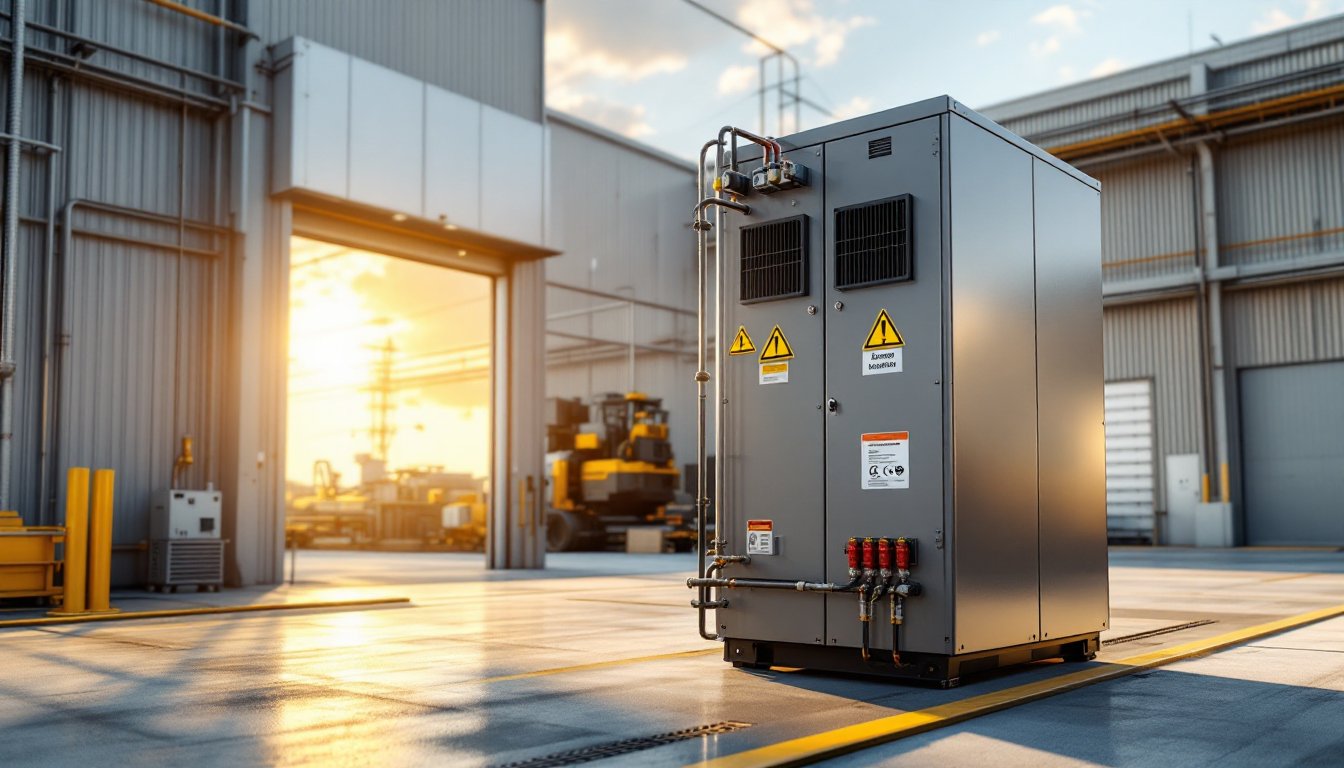
Industrial energy storage isn’t just for utilities anymore. Warehouses, manufacturing plants, data centers, and even some commercial buildings are installing battery systems and mechanical storage to manage peak demand, reduce grid reliance, and stabilize power supply. If your facility runs large equipment, has unpredictable power draws, or faces rising demand charges, understanding industrial energy storage solutions can cut operational costs and improve reliability. This guide walks you through the main technologies, real-world tradeoffs, and practical steps to evaluate what might work for your operation.
Table of Contents
ToggleKey Takeaways
- Industrial energy storage solutions reduce demand charges by 30–50% of electricity costs through peak demand shaving, with potential annual savings of $40,000+ for medium-sized facilities.
- Lithium-ion batteries are the dominant choice for new installations due to high energy density, 3,000–10,000+ cycle life, and minimal maintenance, with ROI breakeven typically achieved in 6–15 years.
- Mechanical storage systems like compressed air, flywheels, and pumped hydro offer alternatives for specific use cases: flywheels excel at rapid response with 80–90% efficiency, while CAES suits infrequent peaking with lower upfront costs.
- A thorough power audit identifying peak demand events, facility electrical topology, and future load growth is essential before selecting an industrial energy storage system.
- Federal 30% Investment Tax Credit and state rebates can reduce net capital costs by $100,000+, significantly improving payback economics for qualifying systems.
- Engage a qualified systems integrator early to coordinate design, permitting, interconnection, and commissioning—skipping this step risks costly errors and regulatory delays.
Understanding Industrial Energy Storage Systems
Industrial energy storage systems act as a buffer between your facility’s power demand and the grid. When demand is low, the system charges: when equipment draws heavy current, the storage discharges to cover the spike. This smooths your electrical load and, more importantly, reduces demand charges, the fees utilities add based on your highest 15-minute power draw each month.
Demand charges often account for 30–50% of an industrial facility’s electricity bill. Shaving even one peak can save thousands monthly. Storage also provides resilience: if the grid drops, a charged system keeps critical loads running during the outage.
The trade-off is upfront cost and ongoing maintenance. A 500-kWh battery system might cost $250,000–$500,000 installed before incentives. Most systems need a 10–15 year horizon to break even. Size, chemistry, and your local utility rates all drive whether the math works for your facility.
Building codes and interconnection rules vary by location. Some jurisdictions require a licensed electrician or engineer to design and install industrial storage systems. Check with your local authority having jurisdiction (AHJ) and your utility before specifying equipment.
Battery-Based Storage Technologies
Batteries are the most common industrial storage choice because they’re scalable, modular, and can respond to demand in milliseconds.
Lithium-Ion vs. Lead-Acid Systems
Lithium-ion dominates new installations. These cells offer high energy density, longer cycle life (3,000–10,000+ full cycles), minimal maintenance, and the ability to discharge at 100% depth of discharge without degradation. A lithium-ion industrial battery system installed today might have a 10–15 year usable life and retain 80% capacity at end-of-life. The upfront cost is higher, but cost per cycle is lower over time.
Lead-acid batteries cost less initially but deteriorate faster, especially with deep cycling. They deliver reliable power and are well-understood, so repairs and replacements are straightforward. Lead-acid typically lasts 5–10 years with moderate cycling and requires regular maintenance: equalizing charges, water top-offs (if not sealed), and terminal cleaning. For a facility running infrequent, short-duration peaking, lead-acid might still pencil out.
Sodium-ion and flow batteries are emerging alternatives. Sodium-ion has lower energy density than lithium but tolerates deeper discharge cycles and costs less. Flow batteries (vanadium redox or zinc-bromine) are excellent for 4+ hour discharge windows but are bulkier and still warming up in the market. Most new industrial projects use lithium-ion unless a specific constraint (heat sensitivity, vibration environment, safety zone restriction) rules it out.
All battery systems need a battery management system (BMS) to monitor cell voltage, temperature, and charge state. A BMS prevents overcharge, manages cell balancing, and triggers shutdown if conditions drift unsafe. This is non-negotiable and adds 10–15% to system cost.
Mechanical Storage Solutions
Mechanical storage doesn’t use batteries. Instead, it converts electrical energy into potential or kinetic energy, then reverses the process when you need power back.
Compressed air energy storage (CAES) pressurizes air into an underground cavern or above-ground tank. When demand peaks, the compressed air drives a turbine to generate electricity. CAES is proven, long-lived (20–40 years), and low-maintenance, but it requires suitable geology or significant capital for tanks. Round-trip efficiency is 40–50%, meaning you lose half the input energy to heat and friction.
Flywheel systems spin a heavy rotor at high speed (5,000–20,000+ RPM) inside a magnetic bearing cage. Energy is stored as rotational kinetic energy. When you draw power, the rotor slows and a motor-generator converts rotation back to electricity. Flywheels excel at rapid response (sub-second) and very frequent cycling (thousands per day). They’re compact, need minimal maintenance, and work in any climate. Round-trip efficiency is 80–90%, far better than CAES. The catch: they’re expensive ($1,000–$3,000 per kWh), best for short bursts (seconds to a few minutes), and gradual self-discharge if you don’t need power immediately.
Pumped hydro is the largest-scale mechanical storage: pump water uphill into a reservoir during low demand, release it through turbines during peak demand. It’s highly efficient (70–85% round-trip), durable (50+ years), and can discharge for hours. New installations are rare because suitable sites are scarce and environmental permits are stringent. It’s worth mentioning for facilities near hydroelectric plants or in regions with hydro infrastructure.
Mechanical systems suit different use cases than batteries. If your facility has infrequent, short peaking events and you can tolerate some efficiency loss, CAES or flywheel might be cheaper long-term. If you need flexible, modular capacity that scales incrementally, batteries are simpler.
Cost-Benefit Analysis and ROI Considerations
Calculating ROI requires honest assumptions. Start by quantifying your demand charges: review 12 months of utility bills and note the peak 15-minute demand in each month. Multiply that peak by your utility’s demand charge rate (often $10–$20 per kW per month). That’s your baseline pain point.
Next, estimate how much peak demand you can shave. If your peak is 1,000 kW and you install a 200-kW/400-kWh battery that discharges for 2 hours during peak, you’re cutting demand by 200 kW. At $15/kW/month, that’s $3,600/month or $43,200 per year in demand savings alone. Some utilities offer demand response programs that pay you to discharge during grid stress events, adding another revenue stream.
Subtract annual operating and maintenance costs. Lithium-ion systems are nearly maintenance-free: assume 0.5–1% of installed cost annually for monitoring and battery health checks. Lead-acid systems might cost 2–3% yearly. Add insurance, which is typically 0.5–1% of capital cost.
Capital cost depends on chemistry, size, and balance-of-system. A delivered, installed 500-kWh lithium battery system runs $250,000–$500,000, or $500–$1,000 per kWh. Lead-acid is $150–$300/kWh. Mechanical systems vary wildly, flywheel is $1,000+/kWh but lasts longer: CAES depends entirely on site geology.
Federal Investment Tax Credit (ITC) covers 30% of qualifying storage systems (check current eligibility). Some states add rebates. A $400,000 lithium system with $120,000 in incentives drops to $280,000 net cost.
Payback period: $43,200 annual savings ÷ ($280,000 net cost + $5,000 annual O&M) ≈ 6–7 years. That’s reasonable for industrial equipment. Storage Solutions Trends 2026: What to Expect in Home and Business Organization outlines how forward-thinking facilities are adopting energy storage as part of broader operational efficiency upgrades.
Note that utility rates, demand charge structures, and incentives change year to year. Get a fresh quote and analysis from a systems integrator before committing.
Selecting the Right System for Your Facility
Start with a power audit. Identify your top 10 peak demand events over the past year: when did they occur, how long did they last, and how much power did you draw? If peaks are short (15–30 minutes) and infrequent, a smaller, cheaper battery system might suffice. If peaks last 4+ hours daily, you need more capacity, and batteries start losing ROI: mechanical storage becomes viable.
Map your facility’s electrical topology. Where is the main breaker? Can you install storage at the primary service entrance, or does your layout require multiple smaller systems? Larger, centralized systems are more efficient, but site constraints often force distributed architecture. A systems integrator walks through this during engineering: don’t skip this step.
Consider your facility’s future. Are you adding production lines, refrigeration, or EV charging? Load growth affects storage sizing. A system sized for today’s peak won’t cover tomorrow’s expansion. Build in 20–30% headroom or choose modular batteries you can add to later.
Review interconnection requirements. Your utility must approve grid connection. Some utilities allow battery discharge back to the grid (increasing revenue): others forbid it. Interconnection timelines can be 3–12 months, so start early. Storage Solutions Tools: Organize Your Space With the Right Equipment includes planning checklists that apply to facility-scale energy projects.
Prospects on Digital Trends report that smart energy management systems are becoming standard in industrial facilities, allowing real-time monitoring and automated dispatch. An energy storage system paired with smart controls maximizes your ROI by timing discharge to match the highest-cost grid hours or demand response events.
Finally, engage a qualified systems integrator or energy consultant early. They coordinate equipment selection, permitting, installation, interconnection, and commissioning. That’s not a “nice-to-have”, it’s how you avoid costly mistakes. What Is Storage Solutions? provides foundational concepts for evaluating any storage technology in a business context.
Conclusion
Industrial energy storage is a capital-intensive but increasingly practical way to manage demand, reduce grid strain, and improve power resilience. Lithium-ion batteries dominate new builds: mechanical systems suit specialized use cases. Calculate your demand charges, quantify peak reduction, include incentives, and model a realistic payback period before proceeding. Partner with an experienced systems integrator, respect local codes and utility rules, and plan for your facility’s growth. The right storage system pays for itself while making your operation more reliable and sustainable.