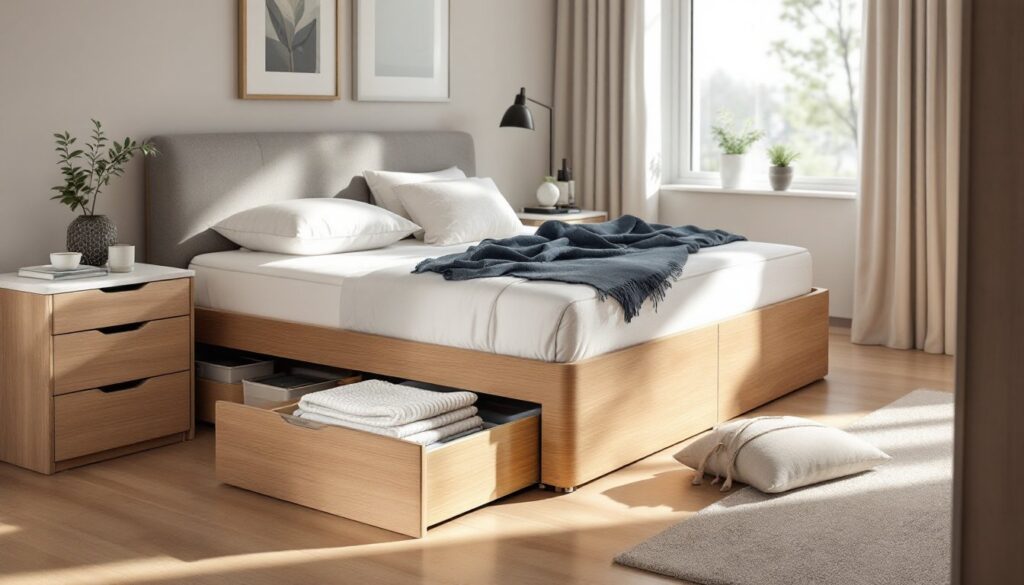


A queen bed dominates the bedroom landscape, yet wasted space beneath it remains one of the easiest missed opportunities in home organization. Storage bed frames solve this problem without cramping your quarters or demanding renovations. Instead of pushing boxes under the frame and pretending they’re not there, a queen bed frame with storage puts dormant square footage to productive use, stashing extra linens, off-season clothing, or pillows within arm’s reach. Whether you’re furnishing a guest room, maximizing a master bedroom, or tackling a small-space bedroom challenge, a storage bed frame keeps clutter contained while maintaining a clean, intentional aesthetic. This guide walks through the types, materials, and practical considerations that’ll help you pick (or build) the right storage bed for your space.
Table of Contents
ToggleKey Takeaways
- A queen bed frame with storage maximizes bedroom organization by converting wasted under-bed space into 10–20+ cubic feet of storage capacity without consuming additional floor space.
- Drawer-style storage beds are the most user-friendly option, featuring smooth ball-bearing slides that make accessing seasonal items, linens, and clothing effortless without lifting the mattress.
- Quality construction matters: solid hardwood frames with mortise-and-tenon joinery and proper hardware outperform budget alternatives made with particleboard and glue-only assembly, which fail within 2–3 years.
- Platform and lift-top storage beds offer maximalist storage for large, infrequently accessed items like suitcases and holiday decorations, though they require more effort and muscle to access.
- Renter-friendly and homeowner-approved, storage bed frames provide visible and functional organization without permanent alterations, eliminating the need for scattered bins and keeping bedrooms visually clean and intentional.
Why Choose a Storage Bed Frame for Your Bedroom
A storage bed frame doesn’t just look tidy, it fundamentally changes how you organize your bedroom. Most bedrooms already have a dresser and a closet, so why add another layer of storage? Because under-bed space is invisible. Once the bed skirt or duvet drops, whatever’s stored below vanishes from sight, keeping visual clutter at bay while maximizing the footprint you’ve already claimed.
Beyond aesthetics, storage bed frames address a practical pain point: seasonal rotation. That heavy winter quilt, the guest-room pillows, or the suitcase you pull out twice a year, all fit neatly in pull-out drawers rather than your closet or a linen closet that’s probably already packed. A queen bed frame with storage effectively adds 10–20+ cubic feet of organization capacity without eating into floor space or requiring wall shelving.
For renters, storage beds are a game-changer. You get the organizational benefit without permanently altering your unit, which means no landlord disputes when you move on. For homeowners, they’re an elegant solution to the perpetual storage shortage that seems universal in bedrooms.
Benefits of Built-In Storage Solutions
Built-in under-bed storage eliminates the constant hunt for baskets, bins, and labels. Drawers are sized to the frame, not some universal container that doesn’t quite fit, so you’re using every inch efficiently. Unlike loose storage boxes that shift, get crushed, or harbor dust, a quality bed frame’s storage compartment integrates seamlessly with the structure. The drawers glide on ball-bearing slides, which means even after years of opening and closing, they move smoothly without sticking or binding.
Another quiet benefit: accessibility. You don’t need a step stool or awkward bending to fish something out from under a traditional bed. Pull-out drawers slide smoothly to full extension, so everything stored is genuinely reachable. This makes the storage functional, not just theoretical. Many people find they actually use under-bed storage consistently because accessing it doesn’t feel like a chore. Families with young kids appreciate the safety aspect too, no reaching under a low bed frame where curious fingers or heads might bump.
From a design perspective, a unified storage bed frame looks intentional and polished. Rather than a patchwork of storage solutions scattered around the room, the bed itself becomes the organizational anchor. Platform beds, low-profile frames, and lift-top designs all keep the bedroom feeling spacious and uncluttered, even in smaller rooms where every visual inch counts.
Types of Queen Bed Frames With Storage
Storage bed frames come in several practical configurations. Your choice depends on what you’re storing, how often you need to access it, and your room’s layout. Let’s break down the three most common types.
Drawer Bed Frames
Drawer-style beds are the most common and arguably the most user-friendly. They feature one or two full-width drawers mounted on ball-bearing slides underneath the frame. A queen bed typically has drawers that measure around 60 inches wide by 30 inches deep by 12–18 inches tall, enough for bulky blankets, pillows, or clothing without eating into your headroom clearance. The drawers roll smoothly, and because they’re integrated into the frame structure, there’s no rocking or wobbling when you load them.
The biggest advantage is simplicity. Drawers don’t require you to lift the mattress or disassemble anything: you just pull. This makes them ideal for everyday items you rotate seasonally. A downside: if your room layout places the foot of the bed against a wall, you can’t open the drawers fully, so measure your room carefully before buying. Some beds feature drawers that roll completely out on one side, offering flexibility. Drawer beds also tend to be lighter than some alternatives, usually 80–150 lbs depending on construction, so moving them isn’t a two-person job requiring a prayer.
Wood construction is standard for drawer beds, though upholstered frames (with fabric or leather) are increasingly popular. Metal or composite materials appear in budget options, but they often feel flimsy. For durability, look for hardwood frames with solid-wood drawer bases rather than particleboard. Quality hardware, real ball-bearing slides and metal corner brackets, makes a noticeable difference over years of use. Building a drawer bed yourself is achievable if you’re handy: detailed step-by-step plans exist for farmhouse-style queen storage beds with drawers that can be completed in a weekend with basic tools.
Platform and Lift-Top Designs
Platform storage beds are solid, no-box-spring-needed frames where the entire under-bed cavity functions as storage. The mattress rests on a series of wooden slats or a solid plywood panel, and the entire platform lifts (via hydraulic struts or manual props) to reveal storage space underneath. This is maximalist storage, you’re not just fitting a drawer or two, you’re utilizing nearly the entire volume beneath the mattress.
Lift-top beds offer the most storage capacity of any design, but they demand more effort to access. You’re lifting a queen mattress (often 50+ lbs) and a foundation platform, which takes both hands and a bit of muscle. That said, they’re perfect for storing large, infrequently accessed items: suitcases, holiday decorations, rolled rugs, or stacks of bins. Some people install gas struts (hydraulic stays) that make lifting easier, though this adds cost and complexity. A platform bed also tends to be heavier, 200+ lbs, so positioning it is a two-person job.
One practical note: make sure you can comfortably access items stored toward the back under-bed. Some people line the platform cavity with low-profile storage containers to keep things organized, but if you’re just tossing items in, you’ll need to shuffle things around to reach the back. Platform beds also sacrifice visual lightness: they sit lower and look more substantial, which can feel heavy in a smaller room.
Headboard Storage Options
Some queen storage beds integrate shelving or cubbies into the headboard rather than the underside. This keeps frequently accessed items, books, glasses, a lamp, your phone, right at hand without bending or stretching. Headboard storage can include open shelves, cabinet doors, drawers, or a combination of all three. They’re especially popular in modern and Scandinavian designs, where the headboard itself becomes a focal point.
The tradeoff is location. Headboard storage doesn’t help if you’re trying to stash bulky seasonal items: it’s better suited for daily-use goods and decorative objects. You’ll also need to consider how the bed sits in your room. If the headboard is against a wall, you get full access. If it’s floating in the middle of the room (a trend in some contemporary layouts), headboard storage becomes less practical. Upholstered headboards with storage typically come in fabric or leather: wood headboards offer a warmer aesthetic and are easier to customize with finishes. Quality headboards use solid wood or quality plywood frames with reinforced joinery, not compressed particle board that sags after a year of use.
Materials and Construction Quality to Consider
What a storage bed is made of directly determines how long it’ll last and how well it performs. Budget frames often fail within 2–3 years because the wood is weak, the joinery is glued (not screwed or mortised), and the hardware won’t withstand repeated opening and closing.
Solid wood (oak, pine, walnut, or maple) is the gold standard for longevity. These woods have density and grain structure that can handle stress and cycles without creaking or warping. Oak and walnut are hardwoods that age well, though they’re pricier. Pine is softer and more affordable, but it’s also prone to dents and moisture movement, especially in humid climates. Hardwood frames should be kiln-dried to minimize wood movement once assembled.
Plywood is acceptable for drawer bottoms, platform slats, and internal structure, but the frame perimeter should be solid wood. Particleboard and medium-density fiberboard (MDF) are cheaper but lack structural integrity: they absorb moisture, sag under weight, and break down over a decade or less. If you’re buying, check the specs: reputable makers specify “solid wood frame” or “hardwood construction,” not just “wood frame” (a vague term that might mean mostly particleboard).
Joinery matters immensely. Beds take constant stress, the mattress and sleeper pressing down, drawers sliding, the frame flexing slightly with movement. Mortise-and-tenon joinery or dowel joinery (where wooden pegs lock joints) creates rigid, long-lasting connections. Screw or bolt joinery is solid if done properly, with enough fasteners and reinforcement plates. Glue-only joinery is a red flag: once the glue fails (and it will), the bed develops play and creaks.
Drawer slides should be ball-bearing slides rated for full extension and at least 100 lbs per drawer. Cheap slides bind and wear out quickly. Lift-top hydraulic struts need to be rated for the platform weight: undersized struts wear out fast and won’t hold the platform open safely.
Finish matters for durability and appearance. Solid stains or polyurethane topcoats protect wood from moisture and spills. Upholstered frames should use quality fabric or leather and have properly stapled seams: cheap upholstery unravels and padding flattens. If building your own, use exterior-grade plywood for drawers, seal all wood with primer and paint or stain before assembly, and invest in quality hardware, it’s where you’ll get the most functional return. The Handyman’s Daughter and Young House Love both document DIY bed-building projects with a focus on construction details and material selection that’ll help you understand what separates a solid build from a wobbly one.
Finally, consider the queen bed’s weight capacity and mattress compatibility. Most quality storage beds are rated for 500+ lbs total (mattress, foundation, and occupants), but check the spec sheet. Some cheaper frames max out at 400 lbs, which might be tight for a heavier mattress or two adult sleepers. Also confirm that the frame accepts a standard queen mattress and foundation (60″ × 80″ base) without gaps or overhang.