
A cluttered bedroom saps energy before the day even starts. Bedroom benches storage offers a simple fix that doesn’t require a whole remodel. These pieces do double duty: they anchor a room visually while providing hidden (or visible) storage for blankets, pillows, off-season clothes, or whatever’s taking over your closet. Whether you’re furnishing a small bedroom that desperately needs breathing room or upgrading a larger master, a well-chosen bench can become your most hardworking piece. This guide walks through the best bedroom bench options, styles, and even DIY builds so you can find exactly what fits your space and budget.
Table of Contents
ToggleKey Takeaways
- Bedroom benches storage combines visual appeal with hidden or visible storage capacity, making them an ideal solution for reclaiming dead space and reducing clutter without remodeling.
- Choose bench dimensions based on room layout and bed size—pair queen beds with 48–54-inch benches and consider depth (12–18 inches for hallway traffic, 18–24 inches for seating comfort).
- Select between open shelving for display appeal, closed storage for dust protection, or hybrid designs with cubbies and drawers to maximize both functionality and aesthetics.
- Material choice matters: solid wood benches handle daily use and heavy items best, while upholstered options add comfort at the cost of some storage accessibility.
- Budget benches ($150–$400) suit rentals, mid-range options ($400–$900) offer the best value for longevity, and high-end pieces ($900+) provide heirloom quality that improves with age.
- DIY bench projects are achievable with basic carpentry skills and cost $150–$600, using pocket hole joinery and quality drawer slides for smooth operation and durability.
Why Bedroom Benches Are a Game-Changer for Storage
A bedroom bench solves a problem most people don’t realize they have: awkward dead space. The foot of the bed, a corner next to the window, or the wall opposite the dresser often sit empty or get piled with random items. A bench reclaims that real estate and turns it functional.
They’re also far less visually heavy than a dresser or armoire. A bench with open legs creates sightlines that make a room feel bigger, crucial in smaller bedrooms. If you go with a closed-base design, you’re hiding clutter while still keeping the footprint compact.
From a practical angle, benches work harder than their footprint suggests. A 48-inch bench can hold enough pillows and bedding to justify clearing an entire closet shelf. Some designs include drawers or cubbies for shoes, scarves, or seasonal items. Others are pure simple seating with a hinged top and a cavernous interior. The versatility is why bedroom benches have become standard furniture rather than luxury.
Maximizing Space With Functional Bench Designs
Layout matters when choosing a bench. A bench at the foot of the bed is standard, but consider the room’s traffic flow first. If the bedroom is a hallway between the master bath and closet, a narrow bench (12–18 inches deep) keeps traffic clear. If the bench is truly a destination, a spot to sit while getting dressed or a cozy reading perch, bump it to 18–24 inches deep for real comfort.
Length should align with the bed. A queen bed is roughly 60 inches wide: a matching bench should be 48–54 inches to feel proportional without crowding nightstands. Twin beds pair well with 36–42-inch benches. These aren’t rules, just guidelines, measure your room and trust your eye.
Material affects both storage and durability. Solid wood benches (oak, walnut, pine) age beautifully and hold weight well, making them ideal if you plan to sit on them daily or store heavy items like winter blankets. Upholstered benches with wood or metal frames add softness and warmth but sacrifice some storage accessibility unless they have a lift-top.
Open Shelving vs. Closed Storage Options
Open shelving benches display neatly folded blankets, throw pillows, or decorative baskets, making organization visible and inviting. The downside: dust settles on everything, and clutter shows. This style works brilliantly if you stay tidy or have a minimalist decor scheme.
Closed storage (drawers, cubbies, or a hinged top) hides mess and protects items from dust. The tradeoff is you’re less likely to see what’s inside and might forget what you’ve stored. Drawers add convenience but reduce total storage volume. A single large cavity (like a captain’s bed base) maximizes capacity at the cost of compartmentalization.
Hybrid designs, open cubbies on top with closed drawers below, give flexibility. You can display favorite throw pillows while hiding off-season items or unsightly plastic storage bins.
Popular Bedroom Bench Styles for Your Home
Modern minimalist benches feature clean lines, tapered legs, and often a single fabric or wood finish. Storage is typically a single drawer or hinged lid. These work in contemporary bedrooms and blend easily into neutral palettes. Expect prices from $300–$800 for solid wood or quality upholstered versions.
Traditional or farmhouse benches lean into warmth with turned legs, beadboard details, or painted finishes. Open cubbies or divided storage compartments are common. A farmhouse bench at the foot of a bed instantly anchors a cottage or country aesthetic. Pricing ranges widely, budget versions start around $250, while custom or heirloom pieces run $1,000+.
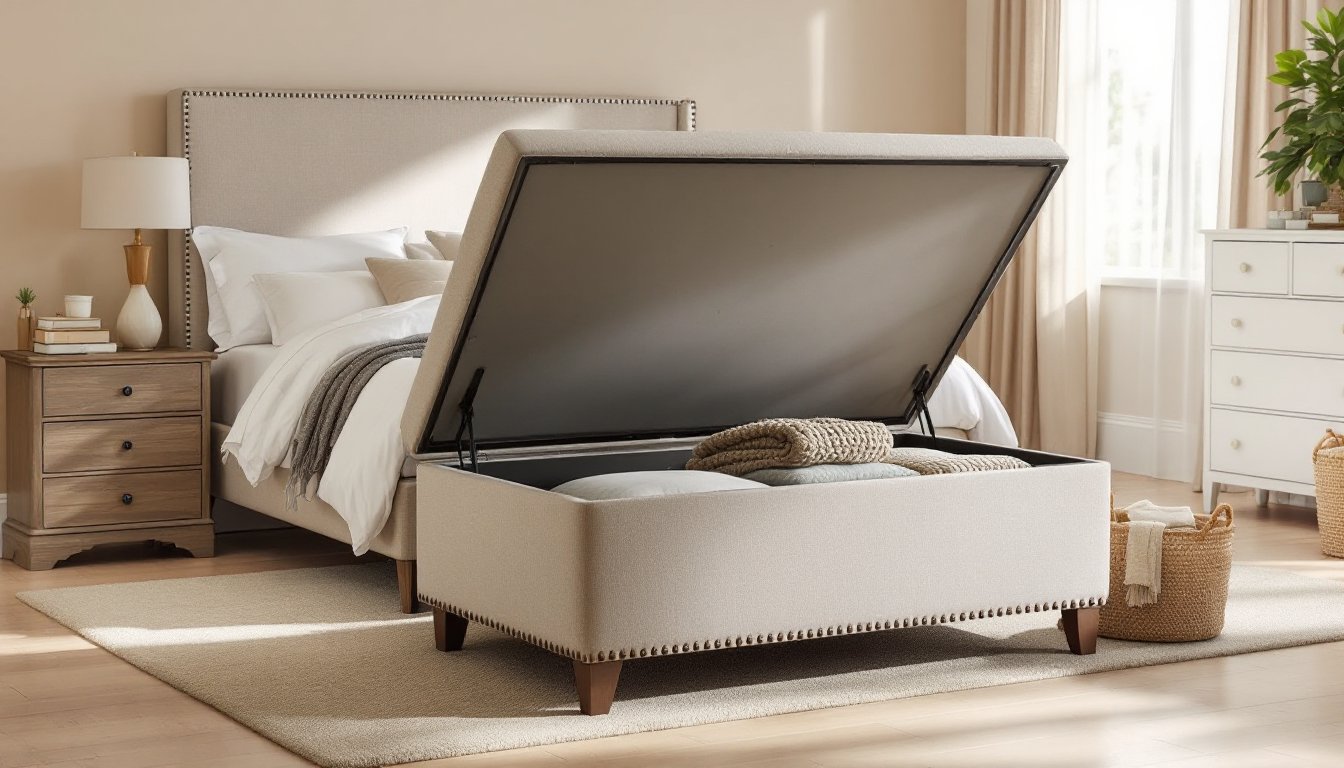
Upholstered benches with nailhead trim or button detailing add luxury and comfort. They’re especially popular in master bedrooms where the bench doubles as a dressing seat. Storage is often underneath via a hinged top or internal frame. Quality upholstered benches start at $500 and escalate with fabric choice and craftsmanship.
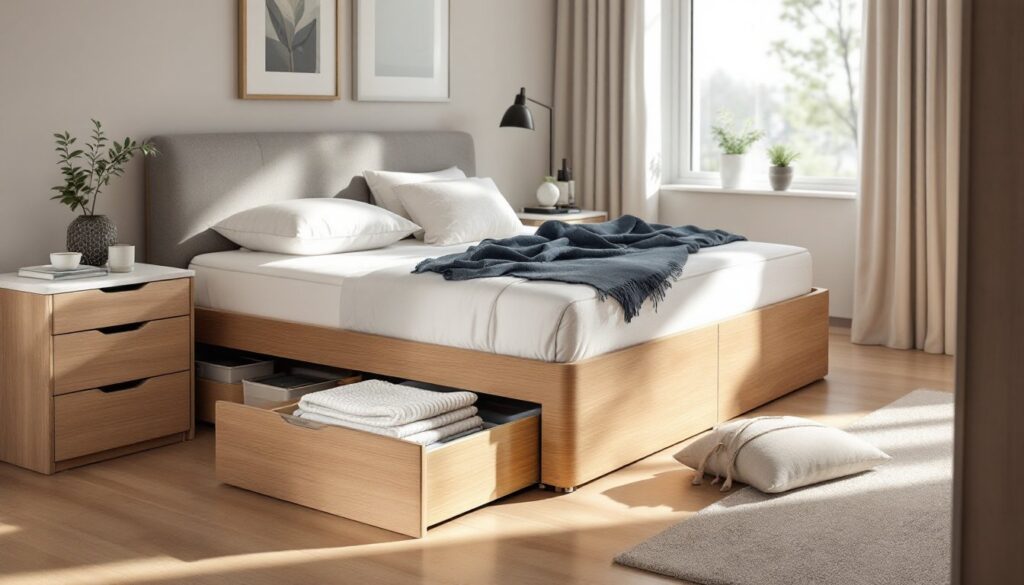
Captain’s bed benches are the storage champion. These lower-profile platforms feature pass-through cubbies along the sides, perfect for throw pillows, bedding, or kids’ toys. Some designs even accommodate a full mattress on top for guest sleeping. Storage Solutions Examples: Smart Ways to Organize Any Space showcases how families maximize cubbies with woven baskets for a polished look.
Bench seat with storage chests combine an upholstered top with a deep lockable chest below. These are ideal if security matters (storing jewelry, medications, or valuables) or if you need to stash large items like a sewing machine or holiday decorations.
Budget-Friendly and High-End Bedroom Bench Options
Budget benches ($150–$400) are typically particle board or MDF frames with basic upholstery or laminate finishes. They’re lightweight, easy to move, and perfectly serviceable for rentals or guest rooms. Watch for wobbly construction, test weight limits before loading with heavy blankets. Big-box retailers and online marketplaces carry dozens of options here.
Mid-range benches ($400–$900) offer real wood veneers or solid wood frames with better joinery and hardware. Drawer slides glide smoothly, and upholstery feels substantial. These represent the best value for most homeowners and will last 10+ years with normal use. Best Storage Solutions for Every Space and Budget details how to evaluate quality at this price point.
High-end benches ($900+) use solid hardwoods, premium upholstery fabrics, and hand-finished details. Dove-tail joinery, kiln-dried lumber, and artisan craftsmanship justify the cost. These are heirloom pieces that improve with age and can be reupholstered or refinished decades later.
Don’t conflate price with practicality. A $300 bench with simple storage and solid legs outperforms a $700 piece with ornate detail that’s poorly made. Read reviews, check return policies, and if buying online, verify dimensions and weight capacity, shipping damage and wrong sizes are common frustrations.
Top Storage Solutions for Every Space and Budget provides side-by-side comparisons of materials and real-world durability so you can match your budget to your actual needs.
DIY Bedroom Bench Projects for Custom Storage
Building your own bench is achievable if you’re comfortable with basic carpentry and have table saw access. A simple frame using 2×4 and 2×6 lumber (nominal sizes: actual dimensions are 1.5″ × 3.5″ and 1.5″ × 5.5″) takes a weekend and costs $150–$300 in materials.
Start by sketching your design and measuring twice. Decide whether you want a hinged top for access or a fixed top with drawers below. Build a rectangular frame with lap joints or pocket holes for strength, pocket hole joinery is forgiving and requires just a basic pocket hole jig ($50 at most hardware stores). Sand everything to 120 grit minimum before staining or painting.
For a hinged storage top, use 1-inch piano hinge rated for the weight of blankets plus whatever you’ll sit on (assume 300+ pounds total). Prop the lid open with soft-close hinges or a simple chain to prevent slamming.
Drawer fronts require more precision. Buy quality drawer slides (full-extension 100-pound capacity runs $15–$25 a pair) and measure diagonals to ensure the frame is square. Family Handyman offers detailed drawer-building tutorials that cover mortising slides and getting smooth action.
For upholstery, measure the top surface, add 2 inches on all sides for wrap-around, and choose a durable fabric (performance fabrics like Sunbrella resist staining). Staple the fabric to the underside of a plywood top using an air stapler, hand stapling is tedious and uneven. Add piping or nailhead trim if you want a finished look (a trim gun makes quick work of nails).
Building a captain’s bed with full-depth storage cubbies is ambitious but rewarding. Expect 20–30 hours and $400–$600 in materials. Instructables hosts step-by-step photo guides for bench builds at various skill levels, start with the simplest design and scale up as confidence grows.
Safety note: Use eye protection and dust masks when cutting and sanding. Pocket hole jigging involves sharp bits, keep fingers clear. If staining, ventilate well and follow product instructions for drying times before assembly.
Conclusion
A bedroom bench is one of those rare pieces that solves a real problem while looking intentional. Whether you buy ready-made or build from scratch, the investment in storage and style pays immediate dividends. Start by measuring your space, knowing your style preference, and being honest about how much weight and use the bench will see. Then pick the design, minimalist, farmhouse, upholstered, or DIY, that fits your bedroom and your budget. Storage Solutions Techniques: Smart Ways to Maximize Your Space provides additional inspiration for organizing what goes inside. Once it’s in place, you’ll wonder how your bedroom ever functioned without it.